-
What OSINT Is — and Why It Is More Than a Google Search
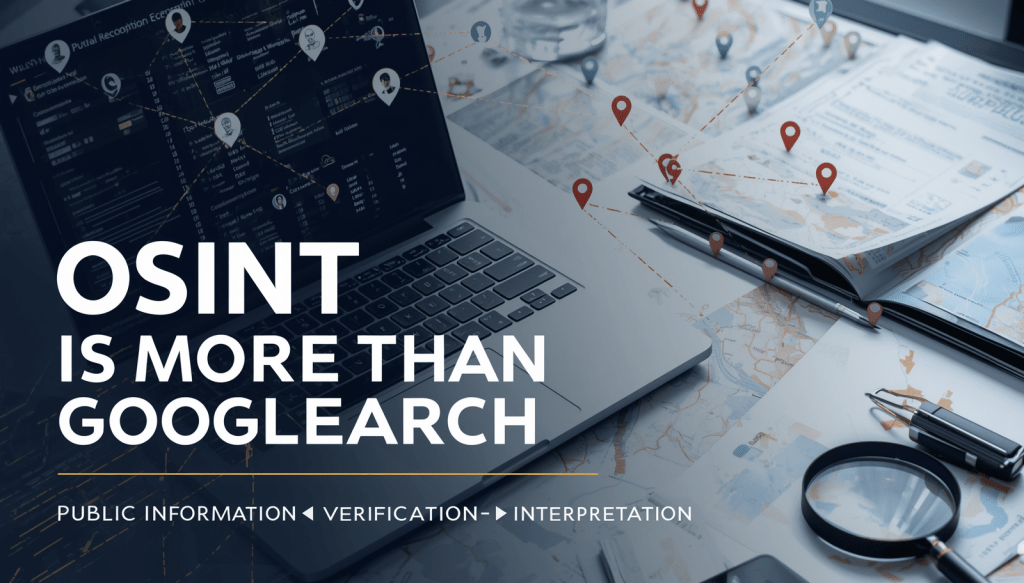
The phrase Open-Source Intelligence can conjure up images of covert CIA operatives, black ops military units, and hooded hackers working in dark rooms.
But in reality, Open-Source Intelligence — commonly called OSINT — is something private investigators, attorneys, and law enforcement agencies use regularly in real-world cases.
Most people have either never heard of OSINT, or they assume it simply means looking someone up online. But an OSINT investigation is not the same thing as a Google search.
OSINT is not valuable because of how much information you can collect. It is valuable because of how clearly you can interpret what that information means.
What OSINT Means
OSINT is the process of gathering information about a subject from publicly available sources.
That sounds simple, but publicly available does not always mean easy to find. Sometimes information is missed because the researcher does not know where to look. Other times, the information may be buried in public records, scattered across multiple platforms, or available only through a paid public-records database.
The key is that the information must be obtained legally and ethically. An OSINT investigator does not hack into password-protected accounts, impersonate someone to gain access, or use illegal methods to obtain private information.
But OSINT is not limited to collection.
A real OSINT investigation also requires verification, organization, and interpretation. A researcher can gather mountains of information, but if that information cannot be verified, connected, and explained clearly to the client, it becomes overwhelming instead of useful.
The goal is not just to collect data.
The goal is to turn publicly available information into something accurate, understandable, and actionable.
What Counts as Open-Source Information
Open-source information can come from many places. It may include public records, online profiles, social media activity, news articles, business filings, court records, property records, archived webpages, images, videos, maps, usernames, websites, blogs, and public government databases.
It can also include details people do not realize they are sharing.
Photos, for example, can sometimes reveal more than the person intended. Depending on how and where an image was uploaded, photos may contain metadata connected to the device, date, time, or location. Even when metadata is stripped away, the image itself may still contain clues: landmarks, signs, vehicles, buildings, weather, clothing, reflections, or background details that help place the image in context.
This does not mean every photo reveals a location. It means photos should be reviewed carefully and responsibly, just like any other source of information.
The important thing to understand is that OSINT is not about accessing private information illegally. It is about identifying, collecting, verifying, and interpreting information that is already legally available.
What OSINT Is Not
OSINT is not about obtaining information illegally, invading someone’s privacy, or stalking another person.
This is one of the most important distinctions a private investigator has to understand. Before accepting an OSINT case, the investigator should consider the client’s reason for requesting the information. Is there a legitimate purpose? Is the client seeking information for a lawful and appropriate reason? Or are there warning signs that the information could be misused?
Not every request should be accepted.
A professional investigator has to be careful not to become a tool for harassment, intimidation, obsession, or harm. If a client does not have a legitimate reason for requesting the investigation, or if their behavior raises serious concerns, it is better to decline the case.
OSINT should be conducted legally, ethically, and responsibly.
OSINT is not:
- Hacking
- Stalking
- Guessing
- Doxxing
- Accessing private accounts
- Secret database access
- Rumor collecting
- Screenshot hoarding
- Harassment disguised as research
- Using information to intimidate or harm someone
The purpose of OSINT is not to violate privacy or feed suspicion. The purpose is to gather, verify, and interpret legally available information for a legitimate investigative reason.
OSINT Is More Than Gathering Data
Collecting data on a subject is only the beginning of an OSINT investigation.
Spending hours searching databases, reviewing social media activity, checking public records, and researching possible criminal history may produce a large amount of raw information. But raw information is not the same thing as a useful investigative finding.
Verification is what separates a lead from a conclusion.
I recently discussed a locate case with another private investigator where this became especially important. The subject had a very common name. Every database search produced pages and pages of possible results. At first glance, it looked like there was a lot of information available.
But once the information was reviewed more carefully, much of it belonged to different people with the same or similar names.
In a case like that, verification becomes critical. A name match is not enough. An investigator has to compare identifiers such as age, location history, known associates, relatives, addresses, employment, court records, and other details before attaching information to the subject.
That is where OSINT becomes more than a search.
Interpreting the information and identifying patterns can be just as important as finding the information in the first place.
In one locate case, I noticed the subject had three young children but only limited visitation. That detail mattered because it suggested there were specific days when he may need to meet with the other parent to exchange the children.
I also learned that two of his major hobbies were rebuilding vehicles at a friend’s shop and online gaming. Those details gave us additional possibilities for locating him and serving legal papers.
That is one example of how OSINT and pattern recognition work together.
The value was not just in finding isolated pieces of information. The value came from connecting those pieces, recognizing behavior patterns, and turning them into a clearer picture for the client.
This is the difference between raw data and intelligence. Raw data is the information collected. Intelligence is what happens when that information is verified, organized, interpreted, and applied to the client’s actual question. Without that step, OSINT can quickly become information overload.
What an OSINT Report Should Do
The final stage of an OSINT investigation is creating a report for the client.
This is where the investigator takes a large amount of information and condenses it into something clear, readable, and useful. Some reports may need to be longer depending on the amount of information involved, but the goal is never to overwhelm the client with every detail collected.
The goal is clarity.
A client does not need a chaotic folder full of screenshots, links, and disconnected notes. They need a clear explanation of what was found, what was verified, what remains unknown, and what the information means in relation to their original question.
This is why it is important to understand the client’s goal before beginning the investigation. What are they trying to find out? What specific questions need to be answered? What information would actually help them make a decision?
A good OSINT report should:
- Answer the client’s main question
- Separate confirmed facts from possible leads
- Identify sources
- Explain relevant patterns
- Note contradictions
- Show what has been verified
- Clarify what remains unknown
- Present findings in plain language
There are also situations where certain information should not be released directly to the client.
For example, someone may hire a private investigator to help locate a biological relative. Maybe an adult adoptee is trying to find a biological parent. In a case like that, the investigator may be able to identify and locate the biological parent, but that does not automatically mean the client should be handed the person’s home address.
In that type of situation, it may be better for the investigator to act as an intermediary.
The biological parent may not want contact. There may be sensitive family circumstances, safety concerns, or a history the client does not know about. The investigator has to consider the rights, privacy, and safety of both parties.
OSINT work is not just about what information can be found. It is also about deciding how that information should be handled.
A professional report should give the client clarity without creating unnecessary risk. The information should be accurate, verifiable, and useful — but it should also be handled responsibly.
How Private Investigators Use OSINT
Private investigators use OSINT in many different types of cases because publicly available information can often provide direction, context, and verification.
OSINT does not replace traditional investigative work, but it can strengthen it. It can help identify leads, confirm details, organize timelines, locate public records, document online activity, and uncover patterns that may not be obvious at first glance.
OSINT can support background checks, case consultations, missing person research, fraud-related concerns, relationship due diligence, witness or subject location research, digital footprint reviews, and public records research.
In each of these situations, the common thread is not just finding information. It is verifying, organizing, interpreting, and reporting that information in a way the client can understand and use.
A private investigator’s job is not to hand the client a pile of links.
The job is to help the client understand what the information means, what can be verified, what remains uncertain, and what steps may make sense next.
When OSINT Becomes a Professional Service
OSINT can be useful in many situations, but it becomes especially valuable when the information is overwhelming, confusing, scattered, or difficult to verify.
Many people begin by doing their own research. They search names, save screenshots, check social media profiles, look through court records, and collect anything they think might matter. Sometimes that is enough. Other times, they end up with a large amount of information but no clear understanding of what it means.
That is where a professional review can help.
As a licensed private investigator, I offer OSINT-based research and case consultations for clients who need help organizing, verifying, and interpreting publicly available information. This may include background checks, public records research, digital footprint reviews, fraud-related concerns, relationship due diligence, locate research, missing person lead review, or case analysis.
The purpose is not to invade anyone’s privacy or chase rumors.
The purpose is to take legally available information and turn it into something clear, structured, and useful.
An OSINT report can help a client understand what has been confirmed, what appears inconsistent, what information still needs verification, and what questions remain unanswered. In some cases, that information may help a client make a personal decision. In other cases, it may help organize information that could be shared with an attorney, law enforcement agency, or other appropriate professional.
Every case is different, and not every request is appropriate for investigation. A legitimate purpose, legal boundaries, and ethical handling of information all matter.
But when OSINT is done correctly, it can bring clarity to situations that feel confusing or chaotic.
Conclusion
OSINT is often misunderstood.
It is not hacking, stalking, spying, doxxing, or collecting rumors from the internet. It is not simply typing someone’s name into Google and assuming the results are accurate.
A real OSINT investigation requires lawful research, careful verification, ethical decision-making, and clear interpretation.
The information itself is only the starting point. The real value comes from understanding what that information means.
That is the difference between a pile of data and an investigative finding.
For clients, that difference matters. A folder full of screenshots may create more confusion. A clear report can help separate facts from assumptions, identify patterns, explain contradictions, and show what remains unknown.
OSINT is not valuable because of how much information can be collected.
It is valuable because of how clearly that information can be verified, interpreted, and explained.
-
What OSINT Is — and Why It Is More Than a Google Search
The phrase Open-Source Intelligence can conjure up images of covert CIA operatives, black ops military units, and hooded hackers working in dark rooms.
But in reality, Open-Source Intelligence — commonly called OSINT — is something private investigators, attorneys, and law enforcement agencies use regularly in real-world cases.
Most people have either never heard of OSINT, or they assume it simply means looking someone up online. But an OSINT investigation is not the same thing as a Google search.
OSINT is not valuable because of how much information you can collect. It is valuable because of how clearly you can interpret what that information means.
What OSINT Means
OSINT is the process of gathering information about a subject from publicly available sources.
That sounds simple, but publicly available does not always mean easy to find. Sometimes information is missed because the researcher does not know where to look. Other times, the information may be buried in public records, scattered across multiple platforms, or available only through a paid public-records database.
The key is that the information must be obtained legally and ethically. An OSINT investigator does not hack into password-protected accounts, impersonate someone to gain access, or use illegal methods to obtain private information.
But OSINT is not limited to collection.
A real OSINT investigation also requires verification, organization, and interpretation. A researcher can gather mountains of information, but if that information cannot be verified, connected, and explained clearly to the client, it becomes overwhelming instead of useful.
The goal is not just to collect data.
The goal is to turn publicly available information into something accurate, understandable, and actionable.
What Counts as Open-Source Information
Open-source information can come from many places. It may include public records, online profiles, social media activity, news articles, business filings, court records, property records, archived webpages, images, videos, maps, usernames, websites, blogs, and public government databases.
It can also include details people do not realize they are sharing.
Photos, for example, can sometimes reveal more than the person intended. Depending on how and where an image was uploaded, photos may contain metadata connected to the device, date, time, or location. Even when metadata is stripped away, the image itself may still contain clues: landmarks, signs, vehicles, buildings, weather, clothing, reflections, or background details that help place the image in context.
This does not mean every photo reveals a location. It means photos should be reviewed carefully and responsibly, just like any other source of information.
The important thing to understand is that OSINT is not about accessing private information illegally. It is about identifying, collecting, verifying, and interpreting information that is already legally available.
What OSINT Is Not
OSINT is not about obtaining information illegally, invading someone’s privacy, or stalking another person.
This is one of the most important distinctions a private investigator has to understand. Before accepting an OSINT case, the investigator should consider the client’s reason for requesting the information. Is there a legitimate purpose? Is the client seeking information for a lawful and appropriate reason? Or are there warning signs that the information could be misused?
Not every request should be accepted.
A professional investigator has to be careful not to become a tool for harassment, intimidation, obsession, or harm. If a client does not have a legitimate reason for requesting the investigation, or if their behavior raises serious concerns, it is better to decline the case.
OSINT should be conducted legally, ethically, and responsibly.
OSINT is not:
- Hacking
- Stalking
- Guessing
- Doxxing
- Accessing private accounts
- Secret database access
- Rumor collecting
- Screenshot hoarding
- Harassment disguised as research
- Using information to intimidate or harm someone
The purpose of OSINT is not to violate privacy or feed suspicion. The purpose is to gather, verify, and interpret legally available information for a legitimate investigative reason.
OSINT Is More Than Gathering Data
Collecting data on a subject is only the beginning of an OSINT investigation.
Spending hours searching databases, reviewing social media activity, checking public records, and researching possible criminal history may produce a large amount of raw information. But raw information is not the same thing as a useful investigative finding.
Verification is what separates a lead from a conclusion.
I recently discussed a locate case with another private investigator where this became especially important. The subject had a very common name. Every database search produced pages and pages of possible results. At first glance, it looked like there was a lot of information available.
But once the information was reviewed more carefully, much of it belonged to different people with the same or similar names.
In a case like that, verification becomes critical. A name match is not enough. An investigator has to compare identifiers such as age, location history, known associates, relatives, addresses, employment, court records, and other details before attaching information to the subject.
That is where OSINT becomes more than a search.
Interpreting the information and identifying patterns can be just as important as finding the information in the first place.
In one locate case, I noticed the subject had three young children but only limited visitation. That detail mattered because it suggested there were specific days when he may need to meet with the other parent to exchange the children.
I also learned that two of his major hobbies were rebuilding vehicles at a friend’s shop and online gaming. Those details gave us additional possibilities for locating him and serving legal papers.
That is one example of how OSINT and pattern recognition work together.
The value was not just in finding isolated pieces of information. The value came from connecting those pieces, recognizing behavior patterns, and turning them into a clearer picture for the client.
This is the difference between raw data and intelligence. Raw data is the information collected. Intelligence is what happens when that information is verified, organized, interpreted, and applied to the client’s actual question. Without that step, OSINT can quickly become information overload.
What an OSINT Report Should Do
The final stage of an OSINT investigation is creating a report for the client.
This is where the investigator takes a large amount of information and condenses it into something clear, readable, and useful. Some reports may need to be longer depending on the amount of information involved, but the goal is never to overwhelm the client with every detail collected.
The goal is clarity.
A client does not need a chaotic folder full of screenshots, links, and disconnected notes. They need a clear explanation of what was found, what was verified, what remains unknown, and what the information means in relation to their original question.
This is why it is important to understand the client’s goal before beginning the investigation. What are they trying to find out? What specific questions need to be answered? What information would actually help them make a decision?
A good OSINT report should:
- Answer the client’s main question
- Separate confirmed facts from possible leads
- Identify sources
- Explain relevant patterns
- Note contradictions
- Show what has been verified
- Clarify what remains unknown
- Present findings in plain language
There are also situations where certain information should not be released directly to the client.
For example, someone may hire a private investigator to help locate a biological relative. Maybe an adult adoptee is trying to find a biological parent. In a case like that, the investigator may be able to identify and locate the biological parent, but that does not automatically mean the client should be handed the person’s home address.
In that type of situation, it may be better for the investigator to act as an intermediary.
The biological parent may not want contact. There may be sensitive family circumstances, safety concerns, or a history the client does not know about. The investigator has to consider the rights, privacy, and safety of both parties.
OSINT work is not just about what information can be found. It is also about deciding how that information should be handled.
A professional report should give the client clarity without creating unnecessary risk. The information should be accurate, verifiable, and useful — but it should also be handled responsibly.
How Private Investigators Use OSINT
Private investigators use OSINT in many different types of cases because publicly available information can often provide direction, context, and verification.
OSINT does not replace traditional investigative work, but it can strengthen it. It can help identify leads, confirm details, organize timelines, locate public records, document online activity, and uncover patterns that may not be obvious at first glance.
OSINT can support background checks, case consultations, missing person research, fraud-related concerns, relationship due diligence, witness or subject location research, digital footprint reviews, and public records research.
In each of these situations, the common thread is not just finding information. It is verifying, organizing, interpreting, and reporting that information in a way the client can understand and use.
A private investigator’s job is not to hand the client a pile of links.
The job is to help the client understand what the information means, what can be verified, what remains uncertain, and what steps may make sense next.
When OSINT Becomes a Professional Service
OSINT can be useful in many situations, but it becomes especially valuable when the information is overwhelming, confusing, scattered, or difficult to verify.
Many people begin by doing their own research. They search names, save screenshots, check social media profiles, look through court records, and collect anything they think might matter. Sometimes that is enough. Other times, they end up with a large amount of information but no clear understanding of what it means.
That is where a professional review can help.
As a licensed private investigator, I offer OSINT-based research and case consultations for clients who need help organizing, verifying, and interpreting publicly available information. This may include background checks, public records research, digital footprint reviews, fraud-related concerns, relationship due diligence, locate research, missing person lead review, or case analysis.
The purpose is not to invade anyone’s privacy or chase rumors.
The purpose is to take legally available information and turn it into something clear, structured, and useful.
An OSINT report can help a client understand what has been confirmed, what appears inconsistent, what information still needs verification, and what questions remain unanswered. In some cases, that information may help a client make a personal decision. In other cases, it may help organize information that could be shared with an attorney, law enforcement agency, or other appropriate professional.
Every case is different, and not every request is appropriate for investigation. A legitimate purpose, legal boundaries, and ethical handling of information all matter.
But when OSINT is done correctly, it can bring clarity to situations that feel confusing or chaotic.
Conclusion
OSINT is often misunderstood.
It is not hacking, stalking, spying, doxxing, or collecting rumors from the internet. It is not simply typing someone’s name into Google and assuming the results are accurate.
A real OSINT investigation requires lawful research, careful verification, ethical decision-making, and clear interpretation.
The information itself is only the starting point. The real value comes from understanding what that information means.
That is the difference between a pile of data and an investigative finding.
For clients, that difference matters. A folder full of screenshots may create more confusion. A clear report can help separate facts from assumptions, identify patterns, explain contradictions, and show what remains unknown.
OSINT is not valuable because of how much information can be collected.
It is valuable because of how clearly that information can be verified, interpreted, and explained.
-
What OSINT Is — and Why It Is More Than a Google Search
The phrase Open-Source Intelligence can conjure up images of covert CIA operatives, black ops military units, and hooded hackers working in dark rooms.
But in reality, Open-Source Intelligence — commonly called OSINT — is something private investigators, attorneys, and law enforcement agencies use regularly in real-world cases.
Most people have either never heard of OSINT, or they assume it simply means looking someone up online. But an OSINT investigation is not the same thing as a Google search.
OSINT is not valuable because of how much information you can collect. It is valuable because of how clearly you can interpret what that information means.
What OSINT Means
OSINT is the process of gathering information about a subject from publicly available sources.
That sounds simple, but publicly available does not always mean easy to find. Sometimes information is missed because the researcher does not know where to look. Other times, the information may be buried in public records, scattered across multiple platforms, or available only through a paid public-records database.
The key is that the information must be obtained legally and ethically. An OSINT investigator does not hack into password-protected accounts, impersonate someone to gain access, or use illegal methods to obtain private information.
But OSINT is not limited to collection.
A real OSINT investigation also requires verification, organization, and interpretation. A researcher can gather mountains of information, but if that information cannot be verified, connected, and explained clearly to the client, it becomes overwhelming instead of useful.
The goal is not just to collect data.
The goal is to turn publicly available information into something accurate, understandable, and actionable.
What Counts as Open-Source Information
Open-source information can come from many places. It may include public records, online profiles, social media activity, news articles, business filings, court records, property records, archived webpages, images, videos, maps, usernames, websites, blogs, and public government databases.
It can also include details people do not realize they are sharing.
Photos, for example, can sometimes reveal more than the person intended. Depending on how and where an image was uploaded, photos may contain metadata connected to the device, date, time, or location. Even when metadata is stripped away, the image itself may still contain clues: landmarks, signs, vehicles, buildings, weather, clothing, reflections, or background details that help place the image in context.
This does not mean every photo reveals a location. It means photos should be reviewed carefully and responsibly, just like any other source of information.
The important thing to understand is that OSINT is not about accessing private information illegally. It is about identifying, collecting, verifying, and interpreting information that is already legally available.
What OSINT Is Not
OSINT is not about obtaining information illegally, invading someone’s privacy, or stalking another person.
This is one of the most important distinctions a private investigator has to understand. Before accepting an OSINT case, the investigator should consider the client’s reason for requesting the information. Is there a legitimate purpose? Is the client seeking information for a lawful and appropriate reason? Or are there warning signs that the information could be misused?
Not every request should be accepted.
A professional investigator has to be careful not to become a tool for harassment, intimidation, obsession, or harm. If a client does not have a legitimate reason for requesting the investigation, or if their behavior raises serious concerns, it is better to decline the case.
OSINT should be conducted legally, ethically, and responsibly.
OSINT is not:
- Hacking
- Stalking
- Guessing
- Doxxing
- Accessing private accounts
- Secret database access
- Rumor collecting
- Screenshot hoarding
- Harassment disguised as research
- Using information to intimidate or harm someone
The purpose of OSINT is not to violate privacy or feed suspicion. The purpose is to gather, verify, and interpret legally available information for a legitimate investigative reason.
OSINT Is More Than Gathering Data
Collecting data on a subject is only the beginning of an OSINT investigation.
Spending hours searching databases, reviewing social media activity, checking public records, and researching possible criminal history may produce a large amount of raw information. But raw information is not the same thing as a useful investigative finding.
Verification is what separates a lead from a conclusion.
I recently discussed a locate case with another private investigator where this became especially important. The subject had a very common name. Every database search produced pages and pages of possible results. At first glance, it looked like there was a lot of information available.
But once the information was reviewed more carefully, much of it belonged to different people with the same or similar names.
In a case like that, verification becomes critical. A name match is not enough. An investigator has to compare identifiers such as age, location history, known associates, relatives, addresses, employment, court records, and other details before attaching information to the subject.
That is where OSINT becomes more than a search.
Interpreting the information and identifying patterns can be just as important as finding the information in the first place.
In one locate case, I noticed the subject had three young children but only limited visitation. That detail mattered because it suggested there were specific days when he may need to meet with the other parent to exchange the children.
I also learned that two of his major hobbies were rebuilding vehicles at a friend’s shop and online gaming. Those details gave us additional possibilities for locating him and serving legal papers.
That is one example of how OSINT and pattern recognition work together.
The value was not just in finding isolated pieces of information. The value came from connecting those pieces, recognizing behavior patterns, and turning them into a clearer picture for the client.
This is the difference between raw data and intelligence. Raw data is the information collected. Intelligence is what happens when that information is verified, organized, interpreted, and applied to the client’s actual question. Without that step, OSINT can quickly become information overload.
What an OSINT Report Should Do
The final stage of an OSINT investigation is creating a report for the client.
This is where the investigator takes a large amount of information and condenses it into something clear, readable, and useful. Some reports may need to be longer depending on the amount of information involved, but the goal is never to overwhelm the client with every detail collected.
The goal is clarity.
A client does not need a chaotic folder full of screenshots, links, and disconnected notes. They need a clear explanation of what was found, what was verified, what remains unknown, and what the information means in relation to their original question.
This is why it is important to understand the client’s goal before beginning the investigation. What are they trying to find out? What specific questions need to be answered? What information would actually help them make a decision?
A good OSINT report should:
- Answer the client’s main question
- Separate confirmed facts from possible leads
- Identify sources
- Explain relevant patterns
- Note contradictions
- Show what has been verified
- Clarify what remains unknown
- Present findings in plain language
There are also situations where certain information should not be released directly to the client.
For example, someone may hire a private investigator to help locate a biological relative. Maybe an adult adoptee is trying to find a biological parent. In a case like that, the investigator may be able to identify and locate the biological parent, but that does not automatically mean the client should be handed the person’s home address.
In that type of situation, it may be better for the investigator to act as an intermediary.
The biological parent may not want contact. There may be sensitive family circumstances, safety concerns, or a history the client does not know about. The investigator has to consider the rights, privacy, and safety of both parties.
OSINT work is not just about what information can be found. It is also about deciding how that information should be handled.
A professional report should give the client clarity without creating unnecessary risk. The information should be accurate, verifiable, and useful — but it should also be handled responsibly.
How Private Investigators Use OSINT
Private investigators use OSINT in many different types of cases because publicly available information can often provide direction, context, and verification.
OSINT does not replace traditional investigative work, but it can strengthen it. It can help identify leads, confirm details, organize timelines, locate public records, document online activity, and uncover patterns that may not be obvious at first glance.
OSINT can support background checks, case consultations, missing person research, fraud-related concerns, relationship due diligence, witness or subject location research, digital footprint reviews, and public records research.
In each of these situations, the common thread is not just finding information. It is verifying, organizing, interpreting, and reporting that information in a way the client can understand and use.
A private investigator’s job is not to hand the client a pile of links.
The job is to help the client understand what the information means, what can be verified, what remains uncertain, and what steps may make sense next.
When OSINT Becomes a Professional Service
OSINT can be useful in many situations, but it becomes especially valuable when the information is overwhelming, confusing, scattered, or difficult to verify.
Many people begin by doing their own research. They search names, save screenshots, check social media profiles, look through court records, and collect anything they think might matter. Sometimes that is enough. Other times, they end up with a large amount of information but no clear understanding of what it means.
That is where a professional review can help.
As a licensed private investigator, I offer OSINT-based research and case consultations for clients who need help organizing, verifying, and interpreting publicly available information. This may include background checks, public records research, digital footprint reviews, fraud-related concerns, relationship due diligence, locate research, missing person lead review, or case analysis.
The purpose is not to invade anyone’s privacy or chase rumors.
The purpose is to take legally available information and turn it into something clear, structured, and useful.
An OSINT report can help a client understand what has been confirmed, what appears inconsistent, what information still needs verification, and what questions remain unanswered. In some cases, that information may help a client make a personal decision. In other cases, it may help organize information that could be shared with an attorney, law enforcement agency, or other appropriate professional.
Every case is different, and not every request is appropriate for investigation. A legitimate purpose, legal boundaries, and ethical handling of information all matter.
But when OSINT is done correctly, it can bring clarity to situations that feel confusing or chaotic.
Conclusion
OSINT is often misunderstood.
It is not hacking, stalking, spying, doxxing, or collecting rumors from the internet. It is not simply typing someone’s name into Google and assuming the results are accurate.
A real OSINT investigation requires lawful research, careful verification, ethical decision-making, and clear interpretation.
The information itself is only the starting point. The real value comes from understanding what that information means.
That is the difference between a pile of data and an investigative finding.
For clients, that difference matters. A folder full of screenshots may create more confusion. A clear report can help separate facts from assumptions, identify patterns, explain contradictions, and show what remains unknown.
OSINT is not valuable because of how much information can be collected.
It is valuable because of how clearly that information can be verified, interpreted, and explained.
-
Subscribe
Subscribed
Have a WordPress.com account? Log in now.

